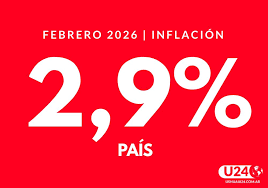
Attorney Guillermo J. Tiscornia formally filed a criminal complaint, considering that an operation based on the use of insider information may have been configured, with a possible conflict of interest and potential influence peddling, all surrounding the publication of the official February CPI data. The judicial presentation was directed to the economic criminal jurisdiction, understanding that this is where the specific competence lies to investigate a fact of this nature. In this sense, the public suspicions disseminated in recent hours appear in the file as a precedent and trigger, but the center of the argument is based on Tiscornia's complaint, which seeks to have the Justice determine if behind those movements there was a deliberate maneuver to influence or benefit from market behavior before the information was available to everyone. Precisely for this reason, he states that if certain operators traded financial instruments with an informational advantage obtained before the public dissemination of the data, the episode could not only fit into a hypothesis of financial agiotage, but also into a typical case of abuse of privileged information. On that basis, Tiscornia requested that summary proceedings be ordered to determine if there were indeed significant transfers from fixed-rate securities to CER-adjusted bonds, if the exact CPI data was already circulating in traders' chats before its publication, and if it can be proven that there was a collusion of operations that allowed obtaining benefits from that advantage. In line with this, he warns that a manipulation based on reserved news or agreements between actors with a relevant position can improperly alter the functioning of supply and demand and harm the set of investors. The complainant also focuses on the possible improper use of privileged information. For the lawyer, this behavior deserves to be investigated as a possible sign of unauthorized access to sensitive information. The complaint also develops an extensive legal foundation on the crime of agiotage and its projection onto financial ground. Tiscornia distinguishes this figure from a classic scam and argues that, in cases of this nature, the legal asset protected is not only good faith in business, but also market transparency, public trust, and the correct formation of prices. In his writing, Tiscornia invoked articles 300, 307, and 309 of the Penal Code, and argued that the episode could be framed within an agiotistic maneuver from the improper use of reserved information, with an impact on stock market operations and on the transparency of the price formation process in the market. According to the complaint, the axis of the case is what happened on March 12, before INDEC officially disseminated February's inflation. Tiscornia took as a basis a journalistic publication that reported on suspicious movements prior to the dissemination of the data, and from there he built the criminal hypothesis. In his argument, he recalls that information is a central asset within the capital market and that not everyone has equal access to it. For the complainant, those movements would not be neutral, but could indicate that certain actors repositioned themselves in advance to obtain a higher return, taking advantage of reserved knowledge about the inflationary data that had not yet been communicated to the entire market. Another of the elements that Tiscornia considered particularly noteworthy was what happened on the Polymarket platform, dedicated to prediction markets. He also requested that, to safeguard the success of the investigation, the dictation of summary secrecy be evaluated and that, in case of identifying responsible parties, the corresponding procedural measures be advanced. The filing does not assert that the crime is already proven, but it does argue that there is a sufficiently plausible criminal hypothesis to open an investigation. There, just before 15:30, the most likely scenario was an inflation between 2.5% and 2.7%. In this framework, he indicated that in the hours prior, versions were already circulating in traders' and investors' chats that placed the index near 2.9%, a percentage that was finally the one officially reported. The writing emphasizes that from around 14:30, purchase and sale operations with greater demand for CER-adjusted bonds or letters began to be observed, along with sales of fixed-rate securities. However, in the last half-hour before the official publication, the probability abruptly shifted towards the 2.8% to 3% range, which ended up coinciding with the figure announced by the statistical body. A criminal complaint filed with the Federal Economic Justice has put under suspicion a possible financial agiotage maneuver linked to movements detected before the dissemination of the latest inflation index. Buenos Aires - March 16, 2026 - Total News Agency - TNA -.